


Does Tulum have an airport? Yes. It’s called Aeropuerto Internacional Felipe Carrillo Puerto, code TQO, taking flights since December 1, 2023. The airport sits about 13 miles from Tulum’s town center. If you’ve been planning your trip around a two-hour drive from Cancun, there’s now a shorter option.
After doing airport pickups across the Riviera Maya for over a decade, I’ve noticed something about TQO specifically. Most people asking about TQO already know it exists. What they actually want to know is whether it’s worth flying into instead of Cancun, and what really happens once you land.
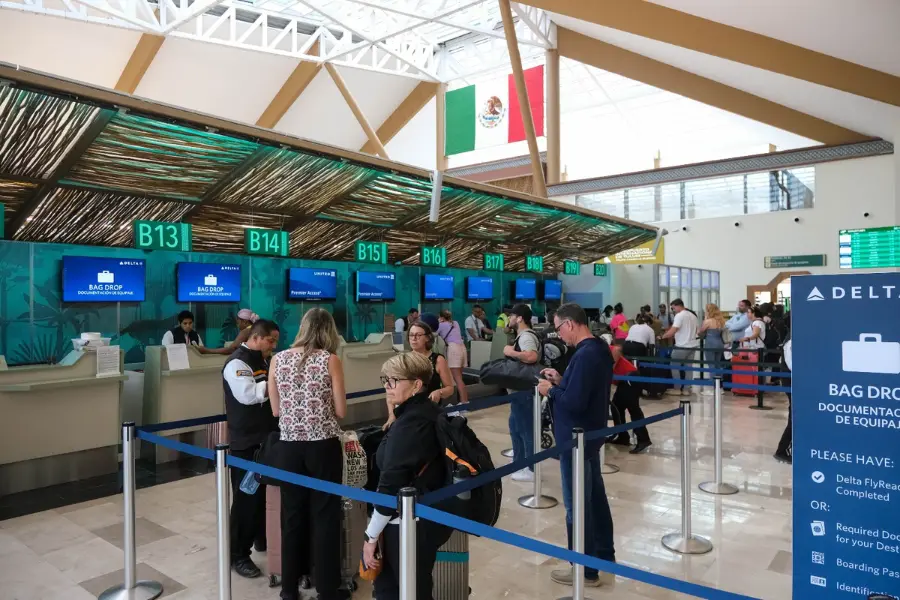
TQO is fully open. It handled well over a million passengers in 2025 and works best for travelers staying in or south of Tulum. Customs here typically takes 20 to 45 minutes, noticeably faster than Cancun. Ground transfers from TQO run higher than from Cancun, so run the math before you book.
Table of Contents (show)
Table of contents
- Where is Tulum Airport located, and how far is it from Tulum Town?
- Which Airports Are Near Tulum, and How Far Is Each One?
- Is Tulum Airport Open? (Current Status 2026)
- Felipe Carrillo Puerto International Airport: Full Name & Code
- Should I Fly into Tulum Airport or Cancun Airport?
- What Actually Happens When You Land at TQO
- Getting to Your Hotel from TQO Airport
- What’s It Like Inside Tulum Airport?
- FAQ
- Explore More Private Tours
Where is Tulum Airport located, and how far is it from Tulum Town?
Technically, Tulum (TQO) Airport sits only about 13 miles from Tulum’s center, roughly 20 kilometers. That’s a 35 to 45-minute drive depending on traffic. However, most international travelers are headed to the Hotel Zone or somewhere south toward Sian Ka’an. That stretches the trip closer to the 45-minute end of the range.
The official name is Aeropuerto Internacional Felipe Carrillo Puerto, named for a former governor of Yucatan. Most people just call it TQO or Tulum Airport. It sits just off Federal Highway 307, the coastal road linking Cancun and Chetumal. An electric shuttle connects the terminal to the Tulum Airport station of the Tren Maya.
SEDENA, Mexico’s military secretariat, built the airport, and Grupo Olmeca-Maya-Mexica runs it today. The scale is real: a 3,700-meter runway, 13 boarding positions, and capacity for up to 5.5 million passengers a year.
Either way, TQO sits closer to Tulum than any other airport, and it clears passengers faster than Cancun too.

Which Airports Are Near Tulum, and How Far Is Each One?
TQO is technically the closest airport to Tulum. Two others are realistic options too, depending on your flights and budget: Cancun International Airport (CUN) and, for island-hoppers, Cozumel International Airport (CZM). Mostly it comes down to flight availability, budget, and how much driving you want on arrival day.
If you’re still getting oriented, where Tulum actually sits on the map helps make sense of why these distances play out the way they do.
Cancun sits about 78 to 80 miles north of Tulum, roughly 125 kilometers, and the drive down runs 1.5 to 2 hours without traffic. It has far more flight options than TQO, which matters more than the extra driving time for a lot of travelers.
Cozumel International Airport (CZM) only makes sense if you’re already island-hopping. You’d take a ferry over to Playa del Carmen, then drive south from there, and that adds real time to the trip.
| Airport | Distance from Tulum | Typical drive time | Best for |
|---|---|---|---|
| Tulum (TQO) | ~13 miles (20 km) | 35-45 min | Staying in or south of Tulum |
| Cancun (CUN) | ~78-80 miles (125 km) | 1.5-2 hours | More flight options, northern Riviera Maya |
| Cozumel (CZM) | Ferry plus drive | Varies | Only if island time is already part of the trip |
Combining Tulum with the Yucatan interior (Chichen Itza, Merida, Valladolid) makes Merida’s airport worth a glance, though it’s a longer drive than any option above.
Bottom line on airports near Tulum: TQO wins on distance, Cancun wins on flight options. Cozumel only wins if an island stop is already on the itinerary.
Is Tulum Airport Open? (Current Status 2026)
Yes. Tulum Airport is open, running domestic and international flights. It’s not under construction or partially operational.
Here’s the nuance worth knowing. Open and running at Cancun’s scale are two different things. Route schedules shift by season here more than at a bigger hub, so check your exact dates on a live flight search before you book. Once you’ve booked, watch for schedule-change emails instead of deleting them.
Where TQO genuinely wins is what happens after you land. Travelers consistently clear customs here in 20 to 45 minutes, dramatically faster than Cancun’s often-packed immigration hall. That’s not a fluke I’ve noticed once. Since TQO opened, every Xaman-Ha Connections pickup we’ve done here has shown the same pattern, and travelers online say it too. More than one Reddit thread describes landing at TQO as fast and quiet. That’s a real contrast to the stories about Cancun baggage waits stretching past an hour.
Felipe Carrillo Puerto International Airport: Full Name & Code
The official IATA code is TQO. The ICAO code is MMTL. When you search on Google Flights, Booking.com, Kayak, or any flight aggregator, use “TQO” or type “Tulum” in the airport field, and both will surface this airport.
The full official name is Aeropuerto Internacional Felipe Carrillo Puerto (Tulum). In casual Mexican Spanish, you’ll see “Aeropuerto de Tulum” used frequently, but formal booking documents use the full name.
For driver coordination or shared transfer bookings, the physical airport address is: Carretera Federal 307 Chetumal-Puerto Juárez Km. 150, 77765 Tulum, Quintana Roo, Mexico.
My personal tip: when you share arrival details with a transfer driver, use “TQO” or the full address above. A few drivers who are new to the area still confuse it with Cancun (I promise you, this happens), and confirming the correct airport upfront saves everyone a headache on arrival day.
Should I Fly into Tulum Airport or Cancun Airport?
It comes down to where you’re staying. If your hotel is in Tulum or anywhere south of it, TQO puts you 30 to 45 minutes from your door instead of two hours. If you’re staying in Playa del Carmen or further north, or you want the widest choice of flights and departure times, Cancun is still the better call.
What Actually Happens When You Land at TQO
Landing at TQO looks nothing like landing at Cancun. Here’s the walk from the jet bridge to the curb, based on what I see happen to arriving travelers, over and over.
First stop is immigration: an officer checks your passport and your FMM, Mexico’s digital tourist entry form. That’s usually quick if you filled it out online ahead of time, and you’re through in a few minutes.
Next is the baggage carousel, where TQO earns its reputation. I’ve never seen the hour-plus waits here that are routine in Cancun, and travelers confirm it independently online. One calls landing at TQO “extremely fast.” Another says landing there felt like paradise, “quiet and relaxed,” after a chaotic Cancun terminal.
Then comes customs, the part that trips people up because it feels inconsistent. It is, on purpose. Mexican customs uses a system called the semáforo fiscal, literally fiscal traffic light. You press a button, and a green light waves you through while a red light means a bag search. It’s genuinely random, decided by the system in that moment, not by anything you did. SAT, Mexico’s tax authority, runs this same random-check model at customs nationwide. That randomness explains why Reddit is split down the middle. Some travelers get a full search, bag by bag, others clear TQO customs twice without a single question.
Every air traveler also gets a duty-free allowance of $500 USD in personal purchases before anything gets taxed, worth knowing if you’re arriving with new gear or gifts.
Change Money Before You Walk Out of the Terminal
One small tip that saves a headache: change some cash to pesos right in the terminal before you walk out. I’ve watched travelers land without a peso, then try to negotiate a taxi fare with nothing but a credit card. Exchange rates at the airport run worse than in town, but changing enough for your first taxi or ADO ticket beats getting stuck without options.
The Sales Pitch Right After Customs
Right after customs, before you even reach the exit, you’ll likely get approached with an offer. It’s a cheap or free taxi ride, sometimes with breakfast or a cenote trip thrown in. The catch: you sit through a sales presentation first. It’s a timeshare-style pitch dressed up as a transportation deal, and travelers report it often enough that it’s not a one-off. My advice: if you didn’t book a transfer in advance, walk past anyone offering a free ride with strings attached. Head straight for the official taxi stand, the ADO counter, or your pre-booked driver instead.
Getting to Your Hotel from TQO Airport
One thing to know before you land: Uber and Lyft don’t operate at TQO. Your options: official taxis, a private transfer, ADO, InDrive, or the Tren Maya shuttle.
Private Transfer (My Top Recommendation)
A pre-booked private transfer is the smoothest way to arrive, especially your first time here. A driver meets you in arrivals with your name on a sign and takes you straight to your hotel. No stops, no negotiating, no surprises.
Private transfers from TQO start at $119 USD for 1 to 3 passengers and $129 USD for 4 to 8. See our Tulum Airport Transfer page for the full rate by destination and to book.
Book at least 24 hours ahead. Last-minute bookings often carry a $20 USD surcharge, and availability gets thin in peak season. It’s a small thing, but the team here doesn’t leave driver-matching to chance. Confirming your exact flight before you land is standard practice at Xaman-Ha Connections, not a last-minute scramble at baggage claim.
Official Airport Taxis and InDrive
Official taxis at TQO run on fixed zone rates, not a meter. Booking through the airport’s official taxi service online, the fare to Tulum Centro runs $57 USD for 1 to 3 passengers and $100 USD for 4 to 9. To the Hotel Zone, it’s $91 USD for 1 to 3 passengers and $135 USD for 4 to 9. Grabbing a taxi curbside instead of booking ahead can run higher, so confirm the total in pesos before you get in, and carry smaller bills so a “no change” problem doesn’t slow you down.
InDrive is the other option travelers mention a lot, an app where you name your own fare instead of accepting a fixed price. Pickup happens at the terminal’s main parking lot, not right outside arrivals, since federal rules keep ride-hailing apps from loading passengers directly at the terminal doors. There’s also Eiby, a similar taxi app with fixed pricing if you’d rather skip the bidding. Either way, confirm the fare with the driver once you’re in the car, and pay when you arrive.
ADO Bus (Best Budget Option)
ADO runs direct buses from the terminal to Tulum Centro, roughly 200-290 MXN, about $12-17 USD, in 45-50 minutes. There’s a proper ADO counter in the terminal where you can pay by card. I’ve taken this bus myself and it’s reliable. Just remember it drops you at the downtown bus terminal, not the beach Hotel Zone, so budget another $5-8 USD for a taxi from there.
Tren Maya (Maya Train)
An 8-minute electric shuttle, about $3 USD, connects arrivals to the Tulum Airport train station. From there it runs north toward Playa del Carmen and Cancun, or south toward Bacalar and Chetumal. If Bacalar is on your itinerary, this genuinely changes the trip. The station still sits about 5 km from downtown, so you’ll need a short taxi.
Car Rental at TQO
Rental counters at TQO include Hertz, Europcar, and others. Online quotes often show $10-15 USD a day, but that rarely includes Mexico’s mandatory TPL insurance. Travelers using their credit card’s built-in coverage instead report renting for around $35-45 USD total for five days. I always tell people to decline the counter’s coverage if their card already has them covered. Just expect a hold of $2,000-5,000 USD either way, so bring printed proof of insurance that covers Mexico.
What’s It Like Inside Tulum Airport?
The terminal is modern and spacious, with Mayan design touches I always point out to first-timers.

Security and immigration move noticeably faster than Cancun, which after a long flight is worth more than any lounge amenity.
One detail that surprises first-timers: there are no jet bridges here. All 13 gates use a hardstand setup. You walk down a set of stairs and across the apron, the paved area where aircraft park, straight to the plane. Wear shoes you can move in, and expect some sun if you’re boarding midday.
Food and drink: there’s a small restaurant serving tacos and hot food, plus fast-food counters and a snack shop. The selection is limited compared to a major hub.

My advice: eat before you head to the airport, or pack something, especially if you’re traveling with kids.
VIPort Lounge: open airside on the mezzanine level after security, 08:30 to 18:30 daily. You can get in with Priority Pass, certain Mastercard programs, or a day pass. It comes with a quiet space, massage chairs, and up to three drinks per adult.
Wi-Fi is free throughout and reliable enough for normal use. Plan to arrive at least 2.5 to 3 hours before an international departure. The terminal itself moves fast; it’s Highway 307 that can slow you down, between checkpoints and construction depending on the season.
FAQ
Is Tulum airport open today?
Yes. TQO is fully open, running domestic and international flights. Check real-time arrivals and departures at aitulum.com or any major flight tracker.
What is the Tulum airport code?
IATA: TQO. ICAO: MMTL.
What is Tulum airport called?
The official name is Aeropuerto Internacional Felipe Carrillo Puerto, named after a former governor of Yucatan. Most people just call it TQO or Tulum Airport.
When was Tulum airport built?
Construction started in 2021 as part of the federal Tren Maya project. Passenger service began December 1, 2023, about two years from groundbreaking to opening.
How do I check which airlines currently fly to Tulum?
The fastest way is a live flight search like Google Flights, since TQO’s route map shifts by season more than a bigger hub’s. Major carriers serve TQO from big US and Mexican hubs, but don’t assume a route still runs from last trip.
Is it cheaper to fly into Cancun or Tulum?
It depends on your dates, not the airport. Run the full math: flight price plus ground transfer. Cancun often wins on flight cost, but TQO can win once you add up the time and transfer savings for a Tulum-area hotel.
Do they search your bags at Tulum airport?
Sometimes, and it’s random. Mexico’s customs system uses a semáforo fiscal, where a button decides who gets a bag search. Plenty of travelers pass through without a question, others get the full search, and neither outcome means you did anything wrong.
Is there Uber at Tulum airport?
No, and Lyft isn’t available either. Your options are official airport taxis, a pre-booked private transfer, the ADO bus, InDrive, or the Tren Maya shuttle.
Once the airport logistics are sorted, plan the rest of your Tulum trip, from where to stay to which ruins are worth the detour.
Tulum’s airport is real, it works, and for the right traveler it cuts a couple of hours off the trip from runway to hotel room. The trick is knowing three things: your route’s daily flight count, the real transfer cost, and your hotel’s location relative to each airport. Get those right, and it’s the better airport. Want an English-speaking driver waiting at baggage claim for a direct ride to your hotel? We’re here to handle that for you. ¡Nos vemos en Tulum!
Explore More Private Tours
Visit our homepage to explore all our services, or browse our Riviera Maya private tour catalog for unforgettable experiences in Riviera Maya and Tulum.
