 Skip to the content


Yes, you can swim with whale sharks in Cancun. Personally, I find it to be one of the most incredible experiences I've ever had when interacting face-to-face with any animal. The season runs from June through mid-September, with peak sightings in July and August. As a local tour guide who has been running these trips for more than ten years, I can tell you the experience is real, the season is short, and most articles online leave out the parts that actually matter for your day.
This guide answers the question directly. Then it walks you through what nobody else explains well: where to depart from, what the day actually looks like in the water and on the boat, and how to tell whether the operator you are about to pay is the right one.
Quick answer:
- Yes, you can swim with whale sharks in Cancun. It is a regulated snorkeling activity, not scuba diving.
- Season: June through mid-September, peak July-August.
- Departure points: Isla Mujeres (best), Cancun (most convenient), Holbox (longest ride).
- Rules: 2-meter minimum distance, no touching, life vests required, licensed operators only.
- Best for: anyone comfortable in open water, willing to give the day 6-8 hours, and prepared for a long boat ride.
Table of Contents (show)
Where to depart from: Cancun, Isla Mujeres, or Holbox?
Travelers ask me this every week, and there is a lot of confusion online. People research, compare prices, read reviews, and end up convinced that if they leave from Holbox, they will see different sharks. Or that from Cancun, the experience is somehow inferior. It does not work that way.
Almost every tour, no matter where you depart from, ends up in the same general area: the waters around Isla Contoy, north of Isla Mujeres. That is where the whale sharks gather during the season. The shark you will see from Isla Mujeres is the same one the boat from Cancun is heading toward that morning. The real difference, the one nobody explains clearly, is how long you spend on the boat before you get there. Trust me, that matters more than people realize when they are planning from home.
| Departure point | Boat time one-way | Water condition | Best for | Watch out for |
|---|---|---|---|---|
| Isla Mujeres | ~1 hour (~60 min) | Calm, open blue water | Best experience with the least fatigue | Crowded docks at dawn |
| Cancun | 1h15 to 1h30 | Calm, fast professional boats | Already staying in hotel zone | No island atmosphere |
| Holbox | 2 to 3 hours | Green and choppy first, then blue | Already have Holbox in your itinerary | Long ride, back and seasickness risk |
Isla Mujeres: my default recommendation
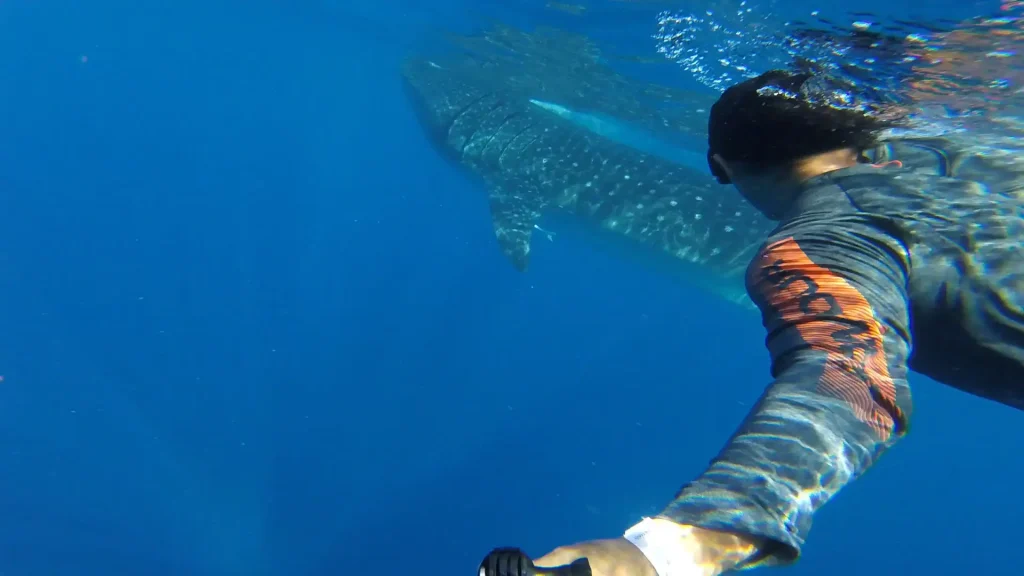
If I had to recommend one without knowing anything else about you, I would say Isla Mujeres. The reason is simple: it is the closest point to the swimming zone. You are looking at roughly one hour on the boat, in calm open water, in genuine Caribbean blue. People arrive at the swim with energy instead of exhaustion. On the way back, many tours stop at Playa Norte for lunch, and it is one of the most beautiful beaches I have ever seen in years of walking these shores.
Cancun: when convenience wins
Cancun does not have the island texture of Isla Mujeres, but it has something else worth a lot: convenience. If you are staying in the hotel zone, leaving from there means you skip the 4 AM ferry transfer to Isla. The boat ride is a little longer, but the boats are fast and professional. The shark is the same. What you lose is the calmer pre-trip rhythm.
Holbox: only if it fits your itinerary
Holbox is a beautiful island, but I will be honest with you. The whale sharks have moved east in recent years, closer to Contoy. What used to be a manageable trip from Holbox can now mean two to three hours each way in a small boat. For someone without back problems or motion sickness, it can be an adventure. For someone who has either, it can be the most uncomfortable memory of the trip.
The shark is the same in all three cases. The difference is how you arrive, and how you go home. After all these years on the water, I can tell you that difference defines the memory of the day far more than people expect.
What the day really looks like
We leave the marina between 5 and 6 AM. Most travelers are still asleep when we are checking equipment, reading the weather, and prepping the group. There is something about that hour I never get tired of. The sea is still dark, the air smells different, and the passengers carry that mix of nerves and excitement that tells me something real is about to happen.
From there, the boat heads north. The ride takes anywhere from one hour (Isla Mujeres) to two or three (Holbox). On the way, my guides give a real briefing. Not a two-minute speech while handing out snorkel gear. A serious conversation about why the rules exist and what the animal actually does when it feels crowded.
Swim alongside, not with
Here is the lesson I repeat most: you are swimming alongside the shark, not with it. Two different things. The whale shark does not belong to you. It has its own rhythm, its own route. When people stop chasing it and start moving beside it, the animal relaxes. So do you. Suddenly you are floating a few feet from the biggest mouth you have ever seen, and the only sound is your own breathing.
Some context to make this lesson land. The whale shark is the largest living fish in the ocean. Whale sharks reach maturity around 9 meters (29.5 feet), and the maximum size on record is thought to be about 20 meters (roughly 65 feet). They can live up to 60 years. At that size, your kicks and your camera shots are meaningless to the shark. The encounter works because you adjust to its movement, never the other way around. Once you stop trying to dictate the moment, the moment opens up to you.
The boat-to-water ratio you should expect
You will spend between 6 and 8 hours from pickup to return. The actual time in the water is short, often broken into two jumps of a few minutes each. That is not bad design. That is how the regulations protect the animal. Travelers who go in expecting an hour-long swim come back disappointed. The ones who understand the ratio go in for the encounter and come back transformed.
Two practical things before the day. If you get seasick easily, take something the night before, not on the boat. And whatever camera you bring, secure it to your body with a strap. The travelers who spend the swim chasing the perfect angle miss the encounter entirely.

How to choose an ethical whale shark tour operator
Start with credentials. A legitimate Cancun operator is licensed by SECTUR, the Mexican Ministry of Tourism. They carry full liability insurance for every passenger and use guides with at least basic safety certification. Whale sharks fall under Mexican federal protection administered by SEMARNAT, and the IUCN lists them as endangered. The shark you are about to swim with is the largest fish in the ocean, not a theme park ride.
Four questions to ask before you pay
- How many people per boat, and per shark in the water?
- Are your guides certified and English-speaking?
- What is your cancellation policy if conditions are bad?
- Do you operate in protected areas following CONANP guidelines?
If the answers are vague, look elsewhere.
Red flags to watch for
Anyone advertising “guaranteed sightings” is either lying or willing to push the rules. Groups larger than 12 in the water at once mean the experience will feel rushed. Prices dramatically below market usually mean the boat is overfilled, the guide undertrained, or both. Wildlife enforcement exists through PROFEPA, but on a busy peak day there are dozens of boats out there and only so many inspectors.
The honest part most operators do not bring up
There is a real difference between regulations on paper and what happens when multiple boats converge on the same shark on a peak July day. The rules are clear. The permits exist. The 2-meter minimum distance is well documented. Marine conservation groups have flagged this kind of high-volume pressure for years. But when you put a hundred swimmers around one animal day after day, what each individual does matters less than the model itself.
At Xaman-Ha we operate small groups always, never large ones. We do a real briefing before anyone enters the water. And on the days when conditions are not right, with too many boats or a clearly stressed animal, we do not get in. Some days the right call is not to swim. These are the principles we apply when we run our whale shark tour from Cancun.
The season for swimming with whale sharks in Cancun runs from roughly June through mid-September, with peak sightings in July and August. The next FAQ section below points you to the full month-by-month season guide if you want timing detail.
Frequently asked questions about swimming with whale sharks in Cancun
When is the best time to swim with whale sharks in Cancun?
The season runs June through mid-September. Peak sightings happen in July and August, when the largest gatherings appear near Isla Contoy. June can be excellent if the weather is calm, and September is less predictable. For the full month-by-month breakdown, see our Whale Shark Season Cancun guide.
Is it safe to swim with whale sharks?
Yes, when you go with a SECTUR-licensed operator. Mexican regulations require life vests, snorkeling only (no scuba diving), and a minimum distance of 2 meters from the animal's body. You do not need to be a strong swimmer. Basic comfort in open water and a willingness to use a flotation device is enough.
Can kids swim with whale sharks in Cancun?
Most operators set the minimum age between 5 and 8 years old, with a parent in the water alongside the child. Life vests make the swimming part accessible, but the long boat ride and open ocean setting can be hard for young kids. My honest take: if your child is not comfortable in deep water, do not push it. There are gentler snorkeling tours along the Riviera Maya that work better for that age.
Who should not book a whale shark tour?
Travelers with severe motion sickness, anyone uncomfortable in open ocean conditions, late-pregnancy travelers, and very young children. A responsible operator asks these questions before taking your money. If yours does not, that is a signal worth noticing.
Ready to swim with whale sharks?
Now that you know how the day actually unfolds and how to recognize an operator that takes the regulations seriously, the next step is booking with one that meets those standards. Our Whale Shark Tour Cancun runs daily through peak season, with small groups, real briefings, and SECTUR-certified guides. We operate from Cancun and Isla Mujeres, and we will tell you honestly if a particular day is not the right one to go out. ¡Nos vemos en el mar!
Explore more private tours in Cancun
Visit our homepage to explore all our services, or browse our Cancun private tour catalog for private, all-inclusive tours departing from Cancun.
