

Whale shark season in Cancun runs from May 15 through September 17. The biggest gatherings happen in July and August, when hundreds of these gentle giants cruise the warm waters north of the Yucatan Peninsula to feed on plankton. If you plan it right, you can experience one of the most unforgettable wildlife encounters on Earth.
I get this question every single season from travelers planning their summer trips. As a local guide who has spent years leading visitors to see these incredible creatures, I can tell you that timing, preparation, and choosing the right operator make the difference between a good experience and an extraordinary one.
Whale shark season in Cancun officially opens on May 15 and closes on September 17 each year, with peak sightings in July and August. Tours depart from Isla Mujeres and Holbox, and the experience involves snorkeling (not diving) alongside the world’s largest fish. Mexican regulations limit group sizes, require certified operators, and protect the sharks under endangered species law.
Table of Contents (show)
Table of contents
- What Are the Official Whale Shark Season Dates for 2026?
- See What a Whale Shark Encounter Looks Like
- How Long Is Whale Shark Season in Cancun?
- 2026 Full Moon Calendar: When to Book for Best Sightings
- Discover Why Whale Sharks Visit Cancun
- Follow the 2026 Regulations for Whale Shark Encounters
- How to Avoid Seasickness on Your Whale Shark Tour
- What Happens If Weather Cancels Your Tour?
- Make the Most of Your Whale Shark Tour
- How to Spot a Certified Whale Shark Operator
- FAQ
- Ready to plan your trip?
What Are the Official Whale Shark Season Dates for 2026?
The 2026 whale shark season runs from May 15 to September 17. These dates come from SEMARNAT’s Área de Refugio decree, published in Mexico’s Official Gazette in 2018, and enforced under the current Plan de Manejo 2025–2027.
Most certified tour operators begin running trips on June 1, when shark concentrations become more reliable. May tours are possible but risky (you might see very few sharks that early). September trips work, but sightings drop off after mid-month.
Month-by-month breakdown
Here’s what to expect from each month based on what I’ve seen over the years:
- May 15 to June 1: Season opens officially. Sightings are inconsistent. Some operators don’t start until June.
- June: Solid start. Shark numbers are growing, and you’ll often share the water with fewer boats. A great choice if you prefer smaller crowds.
- July: Peak season. This is when the largest aggregations happen, sometimes dozens of whale sharks in a single area. Best odds for a spectacular encounter.
- August: Still excellent. Water is warm, sharks are abundant, and conditions are stable.
- September 1 to 17: The tail end. Sharks begin migrating out. Sightings are possible but not guaranteed. I’d avoid booking after September 10 unless you’re flexible.
My advice? Aim for late June through mid-August for the best combination of high shark density and manageable crowds.
See What a Whale Shark Encounter Looks Like
Wondering what it’s actually like to be in the water with a whale shark? This footage was captured during one of our tours near Isla Mujeres.
How Long Is Whale Shark Season in Cancun?
The official whale shark gathering near Cancun lasts about four months, from mid-May to mid-September (roughly 125 days). But the realistic window for reliable sightings is shorter, closer to three months: June through August.
Why the gap? Because whale sharks follow the plankton, not the calendar. Early-season and late-season tours sometimes come back empty. I’ve had guests in late May see zero sharks, and guests in early September see twenty. Nature decides.
The season length is set by CONANP (Mexico’s protected areas commission) under the Reserva de la Biosfera Tiburón Ballena. There has been growing pressure from conservationists to shorten the season to only July and August, though no formal change has been announced for 2026.
If your travel dates are flexible, book for July. If they’re not, anything between June 1 and September 10 gives you strong odds.
2026 Full Moon Calendar: When to Book for Best Sightings
Here’s something most blogs won’t tell you. Experienced captains know that whale shark sightings tend to improve around full moons. Why? Because fish spawning increases near the full moon, which boosts plankton levels, which attracts more sharks to the surface.
2026 full moon dates during whale shark season:
| Full Moon | Date | Ideal Booking Window |
|---|---|---|
| Strawberry Moon | June 29 | June 26 to July 2 |
| Buck Moon | July 29 | July 26 to August 1 |
| Sturgeon Moon | August 28 | August 25 to August 31 |
The strongest window? July 26 to August 1, right around the Buck Moon. That’s peak season combined with peak plankton. If you can choose your dates, this is the sweet spot.
One important note: this isn’t a guarantee. Weather, currents, and ocean conditions still play the biggest role. But if you have flexible dates, booking around a full moon tilts the odds in your favor, especially during the Cancun shark migration peak.
Discover Why Whale Sharks Visit Cancun
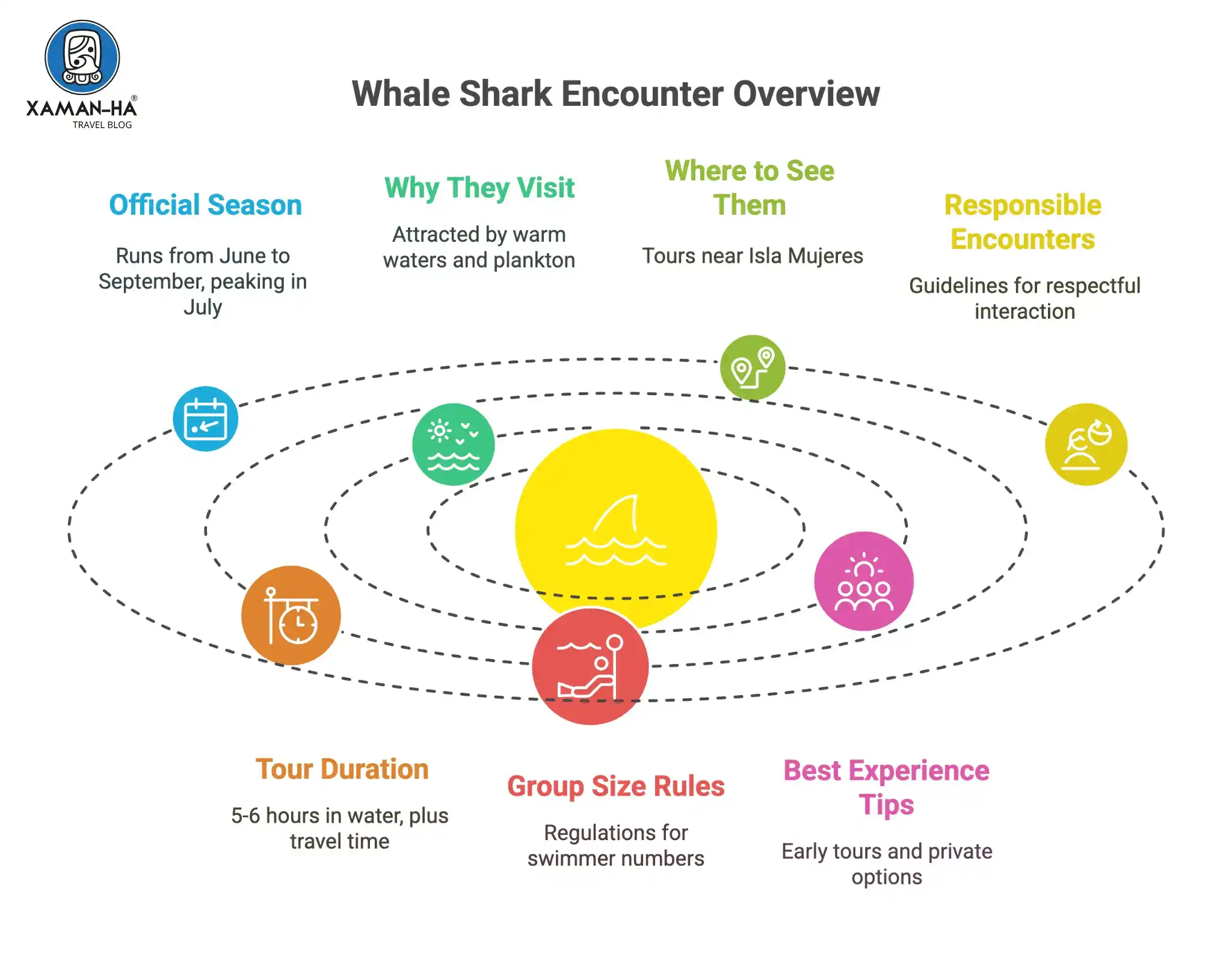
Why do whale sharks flock here in such numbers? Warm seas ranging from 70°F to 86°F (21°C to 30°C), plus a banquet of plankton that blooms each summer, create the perfect feeding grounds. The convergence of Caribbean and Gulf of Mexico currents north of the Yucatan Peninsula pushes nutrient-rich water to the surface, triggering massive plankton blooms.
Some researchers even believe this meeting spot provides an ideal environment for reproductive activities. A 2022 drone study by UMass researchers documented the aggregation zone in detail, though it also found that whale shark density has decreased compared to 2016 observations.
Whale sharks are classified as Endangered by the IUCN. That’s one reason why Mexican regulations around this activity are strict (and why choosing a certified operator matters so much).
If you’re wondering whether you can safely hop in the water with them, check out can you swim with whale sharks in Cancun?
Follow the 2026 Regulations for Whale Shark Encounters
Mexico takes whale shark conservation seriously. SEMARNAT reclassified the whale shark as “Amenazada Tipo A” (Threatened Type A) under NOM-059-SEMARNAT-2010 in May 2025, raising the legal bar for all tour operators.
Current rules you need to know
- Maximum 2 swimmers per whale shark at any time (buddy system required).
- Stay at least 3 meters from the body and 4 meters from the tail.
- No touching. Their protective mucus layer is easily damaged by human contact.
- Snorkeling only. SCUBA diving with whale sharks is illegal in Mexico.
- No flash photography. It can startle the animals.
- Maximum 120 boats per day in the aggregation zone, each carrying no more than 10 tourists plus 3 crew.
- 6 swimmers maximum in the water per boat at any given time.
- Biodegradable sunscreen only. Regular sunscreen damages plankton. Wear a long-sleeve rash guard instead (my recommendation).
- GPS-equipped life vests are mandatory for all swimmers.
- 2 swim entries per person per day maximum.
These rules exist for a reason. In 2024, federal inspectors from PROFEPA and CONANP inspected 53 boats and suspended 5 for lapsed permits or missing authorizations. Choosing a certified operator protects both you and the sharks.
Pregnant guests are not allowed on these tours, and an adult must accompany children.
How to Avoid Seasickness on Your Whale Shark Tour
I won’t sugarcoat this: the boat ride to the whale shark zone can be choppy, especially on windy days. Seasickness is the number one complaint I hear from guests, and it’s almost entirely preventable with a little preparation.
Pedro’s pre-tour checklist
If you’re prone to motion sickness (or if you’ve never been on an open-water boat), take Bonine (meclizine) about one hour before boarding. It’s the best over-the-counter option because it causes less drowsiness than Dramamine. According to the CDC, motion sickness medication works best when taken before symptoms start.
What to eat (and what to avoid)
Eat a light breakfast about 45 to 60 minutes before departure. Eggs on toast, oatmeal, or fruit work well. Avoid greasy food, spicy dishes, orange juice, and coffee. Never board on an empty stomach (the nausea is actually worse without food).
Stay hydrated. Bring a water bottle and take small sips throughout the trip.
On the boat
Sit near the center of the boat, close to the captain. That’s where you feel the least movement. Keep your eyes on the horizon, not on your phone. And here’s a tip most people don’t know: getting in the water actually helps. Once you’re swimming alongside the whale sharks, the nausea usually disappears almost instantly.
What Happens If Weather Cancels Your Tour?
This is one of the most common questions I get, and almost no blog answers it. Whale shark season overlaps with hurricane season (June through November), so weather cancellations are a real possibility.
If sea conditions are unsafe (high waves, strong winds, incoming storms), your operator will cancel the tour. This is for your safety, and honestly, you wouldn’t want to be out there in rough seas anyway.
Most reputable operators offer rescheduling if weather forces a cancellation. We allow cancellations up to 24 hours in advance, and weather-related cancellations are always rescheduled when possible.
My advice? Don’t book your whale shark tour on your last day in Cancun. Give yourself at least one backup day in case weather doesn’t cooperate.
Make the Most of Your Whale Shark Tour

Timing is everything. Consider an early-morning departure for smoother seas and calmer crowds. Tours that leave from Isla Mujeres or Punta Sam typically reach the shark zone faster than those departing from Cancun’s Hotel Zone.
In a typical group tour, you can expect around two brief swims with the whale sharks. Each entry lasts about 5 to 10 minutes. If you want more time in the water and a less crowded experience, a private tour is worth considering. You’ll get more flexibility with timing, fewer people sharing the boat, and a guide who can adapt to conditions.
At Xaman-Ha Connections, we provide an eco-certified whale shark tour with hotel pickup from Cancun, Playa del Carmen, or Tulum, bilingual guides, all snorkeling gear, and lunch at Isla Mujeres. Our boats carry a maximum of 10 guests and follow every SEMARNAT regulation on this list. If you’d rather have a private boat for your own group, we can arrange that for you too.
Want to compare all the options? Check out the best time to see whale sharks in Cancun for month-by-month planning, or browse our Swimming with Whale Sharks tour for details on what’s included.
Quick facts to remember
- Cancun whale shark viewing season: May 15 to September 17, 2026. Peak: July and August.
- Tour length: About 5 to 6 hours total, including boat travel.
- Location: Tours head to the waters north of Isla Mujeres, near the whale shark aggregation zone.
- Group size: Maximum 10 tourists per boat. Maximum 6 swimmers in the water at once.
- Seasonal visitor cap: CONANP limits the aggregation zone to 80,000 total visitors per season. Book early, especially for July.
How to Spot a Certified Whale Shark Operator
Not every company offering whale shark tours is operating legally. In 2024, PROFEPA shut down 5 of 53 boats inspected for expired permits. Here’s how to protect yourself:
- Ask for the SEMARNAT authorization number. Every certified operator must display their valid permit flag on the boat. If they can’t show it, that’s a red flag.
- Check for propeller guards. Regulations require all boats in the whale shark zone to have propeller guards installed. No guard? Walk away.
- Avoid suspiciously cheap tours. If someone offers a whale shark tour at half the market price, they’re likely cutting corners on safety, permits, or both.
- Read recent reviews. Look for specific mentions of guide quality, safety briefings, and respect for the regulations.
My recommendation? Book with operators who are transparent about their permits, follow the two-swimmer-per-shark rule, and provide a proper safety briefing before you enter the water. We take this seriously because these animals deserve respect, and your safety depends on it.
FAQ
How far in advance should I book a whale shark tour in Cancun?
At least 2 to 3 weeks ahead for July and August. The 80,000 seasonal visitor cap means spots fill up fast during peak months. June and September bookings can sometimes be made a week out.
Is mid-September too late for whale sharks in Cancun?
It’s risky. The season officially ends September 17, but shark numbers drop off after the first week of September. If your trip falls in mid-September, book early in your stay so you have a backup date.
Can children swim with whale sharks?
Yes. Children ages 6 to 7 and older can join if they are comfortable swimmers. An adult must accompany them, and life jackets are mandatory. Check with your operator about specific age policies before booking.
What does the 80,000 visitor seasonal cap mean for me?
CONANP limits total visitors in the aggregation zone to 80,000 per season. In peak years, this cap creates real scarcity in July and August. Early booking is the safest strategy, especially if your dates are fixed.
Are whale shark tours in Cancun ethical?
When done by certified operators following SEMARNAT rules, yes. The key is choosing operators who respect distance rules, limit swimmers per shark, use biodegradable products, and prioritize the animals’ wellbeing over photo opportunities. Look for operators who follow the responsible whale shark tourism guidelines published by WildCoast.
Ready to plan your trip?
Visit our homepage to explore everything we offer, or browse our Riviera Maya private tour catalog for unforgettable experiences in Yucatán, Tulum, Cancun, and Riviera Maya.